Medical School Interview-invite Rates in Canada: A Retrospective Cohort Study
Abstract
Intro: In this study, we sought to answer the following questions:
What is the interview invitation rate for medical school applicants in Canada?
Do students who pay for medical school application review services achieve higher rates of interview invitation than those who do not?
Methods: We calculated the interview invitation rate at every English-speaking medical school in Canada for which official publicly available data were available, as of May 16, 2026. We then calculated the interview invitation rate for students who had worked with Canadian Premed for application review over the preceding 2.5 years.
Results: Across all Canadian English-speaking medical schools for which official public data were available, 47226 applications were submitted, and 7783 interview invitations were reported. The mean per-school interview invite rate was 21.52%. The interview invitation rate for students who had worked with Canada Premed for application review was 50.39% (n = 127).
Discussion: Our study is the first of its kind to report on interview-invitation rates for English-speaking medical schools in Canada. These data suggest that students who purchased application review services received interview invitations at a higher rate than the general pool of Canadian medical school applicants.
Conclusions: Our results suggest that students who worked with us for their medical school application review were 2.34 times more likely to receive an interview invitation, compared to the general pool of medical school applicants in Canada. (50.39/21.52% = 2.34).
Introduction
Medical school admissions consulting companies typically advertise extraordinarily high acceptance rates (e.g., 90% or higher) for their previous students. These rates are in stark contrast to the Canadian national average acceptance rate of approximately 5-15% (Table 1). This discrepancy raises skepticism about the validity of their claims and their statistical methodologies.
Broadly speaking, the medical school application process can be broken up into 2 phases:
Phase 1: Application submission → Interview Invitation
Phase 2: Interview Invitation → Offer of admission
In a prior study, we found that students who had worked with Canadian Premed for interview preparation had a per-cycle, post-interview acceptance rate (i.e., phase 2 success rate) of 70.5%, compared to the Canadian national average of 32.2%. However, to our knowledge, there are no existing studies that quantify the post-application submission interview invitation rate. In this study, we sought to answer the following questions:
What is the interview invitation rate for medical school applicants in Canada?
Do students who pay for medical school application review services achieve higher rates of interview invitation than those who do not?
Methods
Data Collection & Analysis (all applicants)
To quantify the interview invitation rate for all English-speaking Canadian medical schools, we gathered the number of applications and the number of interview invitations listed for each school through official public sources that were available on May 16, 2026. If a medical school had listed more than 1 cycle’s worth of admission statistics, we used the data from the most recent application cycle in our calculations. Altogether, we were able to collect data for the following medical schools: University of Toronto, McMaster University, Queen’s University, Western University, University of Ottawa, NOSM University, Toronto Metropolitan University, University of British Columbia, University of Alberta, University of Calgary, University of Manitoba, University of Saskatchewan, Dalhousie University, Memorial University and McGill University. The only English-speaking medical school for which publicly available data were not available was Simon Fraser University. As of May 16, 2026, all schools had updated admission statistics for the 2024-2025 application cycle, except McGill, which had updated its statistics for the 2025-2026 application cycle. We calculated the mean interview-invite rate by averaging the mean interview invitation rate at each school. We also calculated the pooled interview invite rate by dividing the total number of invitations by the total number of applicants.
Data Collection & Analysis (our students)
Using customer data available from the Canadian Premed website order tracking system, we identified 127 unique students who had placed orders for one of our medical school application review services between April 2023 and December 2025 (i.e., OMSAS Autobiographical Sketch Review, University of Toronto Essay Review, Alberta Bundle, etc.). Of these 127 students, we knew that 55 of them had received a medical school interview either because they told us or they posted about their medical school interview/acceptance on social media. Of the remaining 72 students, we were aware that 3 students had received interview invitations at non-Canadian schools (e.g., medical schools in the US, Ireland or Australia) and that 1 student did not receive a medical school interview. We did not know whether the remaining 55 students had received a medical school interview or not.
To gather data on the remaining 55 students, we sent out a survey to their e-mail addresses on file and incentivized them to provide us with the outcome of their medical school application with a $10.00 Amazon gift card. Three e-mail reminders were sent to these students between May 18, 2023 and June 1, 2026. By the time that the survey had closed, we had received responses from 29 of the 55 students. Of these 29 students, 9 indicated that they had received a medical school interview in Canada and 3 indicated that they received a medical school interview abroad (e.g., US, Australia, Ireland, etc.).
Results
Based on the results of this study, students who worked with Canadian Premed for their medical school application review had an interview invitation rate of 50.39%. This number is significantly higher than the national average interview invitation rate of 20.74% for all English-speaking Canadian medical schools.
Interview Invitation Rates for Students who worked with Canadian Premed
Interview Invitation Rates at Canadian Medical Schools
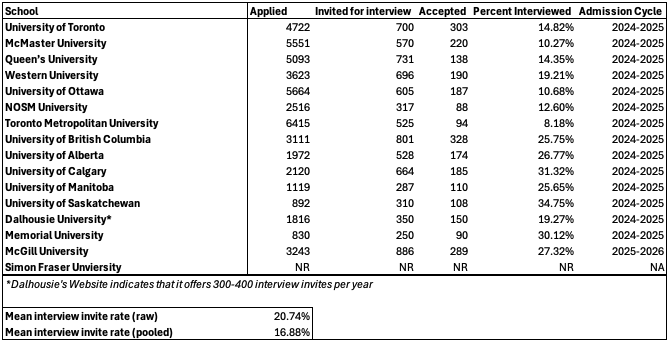
Table 1. Based on the most up-to-date data as of May 16, 2026, the mean interview invitation rate was 20.74% across all English-speaking medical schools.
Discussion
Our results suggest that students who worked with Canadian Premed for their medical school application review were 2.34 times more likely to receive an interview invitation than the general pool of medical school applicants in Canada. In absolute terms, students who worked with Canadian Premed were 29.65% more likely (50.39% - 20.74% = 29.65%) to receive an interview invitation at a Canadian medical school.
As previously stated, companies that advertise “success rates” higher than 90% should be approached with extreme skepticism, as it is unclear how they arrive at such claims. Given the relative ease of getting into medical school in America compared to Canada, companies serving both countries may have an artificially elevated “success rate” due to their American students. It is also possible that such claims are simply made up, having no basis in reality.
In our view, success rates in the context of Canadian medical school applications should be broken down into 2 phases:
Phase 1: Application submission → Interview Invitation
Phase 2: Interview Invitation → Offer of admission
A medical school admissions company that is able to provide a tangible benefit at phase 1 may not necessarily provide such benefits at phase 2, and vice versa. As students typically purchase application review services separately from interview preparation services, it is useful for students to know if they can expect to receive tangible benefits at both phases.
Strengths & Limitations:
To our knowledge, this study is the first of its kind to systemically quantify the interview invitation rates at Canadian medical schools. To gather baseline data on the general applicant pool, we used publicly verifiable data from official sources in our analysis. One limitation of this study is that we do not know the exact number of schools the average Canadian applicant applied to during the time frame encompassing our data set. Additionally, we do not know how many students were invited for more than one interview during this time. Publicly available data from the OMSAS website indicates that in the 2024-2025 admission cycle, 24312 applications were submitted to Ontario medical schools by a total of 7697 applicants. These numbers suggest that, at least in Ontario, the average medical school applicant applied to approximately 3 medical schools (i.e., 24312/7697 = 3.16). This volume is consistent with the approximate number of medical schools that the average student who worked with Canadian Premed applied to. Unfortunately, these data are not available for schools outside of Ontario, given that every other Canadian medical school operates an independent application process. Additionally, as this study only sought to gather the overall interview invitation rate of students who had worked with Canadian Premed, we were not able to quantify the interview invitation rate on a per-school basis for our students.
To quantify the baseline interview invitation rate for all medical schools, we divided the number of interview invitations by the number of applications received on a per-school basis (Table 1). Using this data, we could have estimated the national medical school interview invitation rate in 2 ways:
Pooled averaging: Dividing the sum total interview invitations by the sum total applications across all medical schools included in the study or;
Mean of means: Calculating the interview invitation rate on a per-medical school basis, then calculating the mean of those per-school interview invitation rates
Following the “pooled average” method, we found that 16.88% of medical school applications resulted in an interview invitation from the school that was applied to, whereas the “mean of means” method produced an interview invitation rate of 20.74%. As previously mentioned, we do not know the average number of medical schools each applicant applied to during the timeframe encompassing our dataset. However, given that our estimates from the OMSAS dataset suggest that, at least in Ontario, the average applicant applies to approximately 3 different medical schools, we chose to use the “mean of means” method as it produced a higher estimate for the baseline interview invitation rate. Regardless of the method we choose to derive our baseline estimate, we anticipate that students are most interested in the interview invitation rate at the specific school(s) to which they plan to apply. These data are readily summarized in Table 1.
References:
https://ugme.healthsci.mcmaster.ca/admissions/after-you-apply/
https://meds.queensu.ca/academics/mdprogram/admissions/admissions-statistics
https://www.schulich.uwo.ca/med-dent-admissions/medicine/admission-statistics.html
https://www.uottawa.ca/faculty-medicine/undergraduate/admissions
https://mdprogram.med.ubc.ca/admissions/before-you-apply/admissions-statistics/
https://www.afmc.ca/wp-content/uploads/2025/08/CMES-2024-EN-SectionF.pdf
https://www.umanitoba.ca/explore/sites/explore/files/2021-08/MedicineAdmissionsStatistics.pdf
https://medicine.usask.ca/documents/Admissions/admissions-statistics-document.pdf
https://medicine.dal.ca/departments/core-units/admissions/about/class-profile.html
https://www.mcgill.ca/medadmissions/after-youve-applied/currentapplicantstats
Conflicts of Interest:
The author operates Canadian Premed (www.canadianpremed.ca), paid interview preparation and application review services for Canadian medical school applicants. Client outcomes reported in this study are used to inform and market our services. No external funding or third-party influences were involved in data collection, analysis, or reporting.
Disclosures:
All data was derived from internal tracking and voluntary client surveys, with methods detailed above for full transparency. All data were anonymized for the statistical analysis of this study. Please note that while this study was designed to be fair, transparent and representative of our client’s outcomes, this study has not been submitted to a peer-reviewed scientific journal at the time of writing.